Team HeroKindness™ · Season 0
Ages 7–12 · Teens 13–17
Kindness Skill-Certified
Helper Hank
Hank Handrise™ · Skill: Help Choice
“I’ve got a hand for that.”
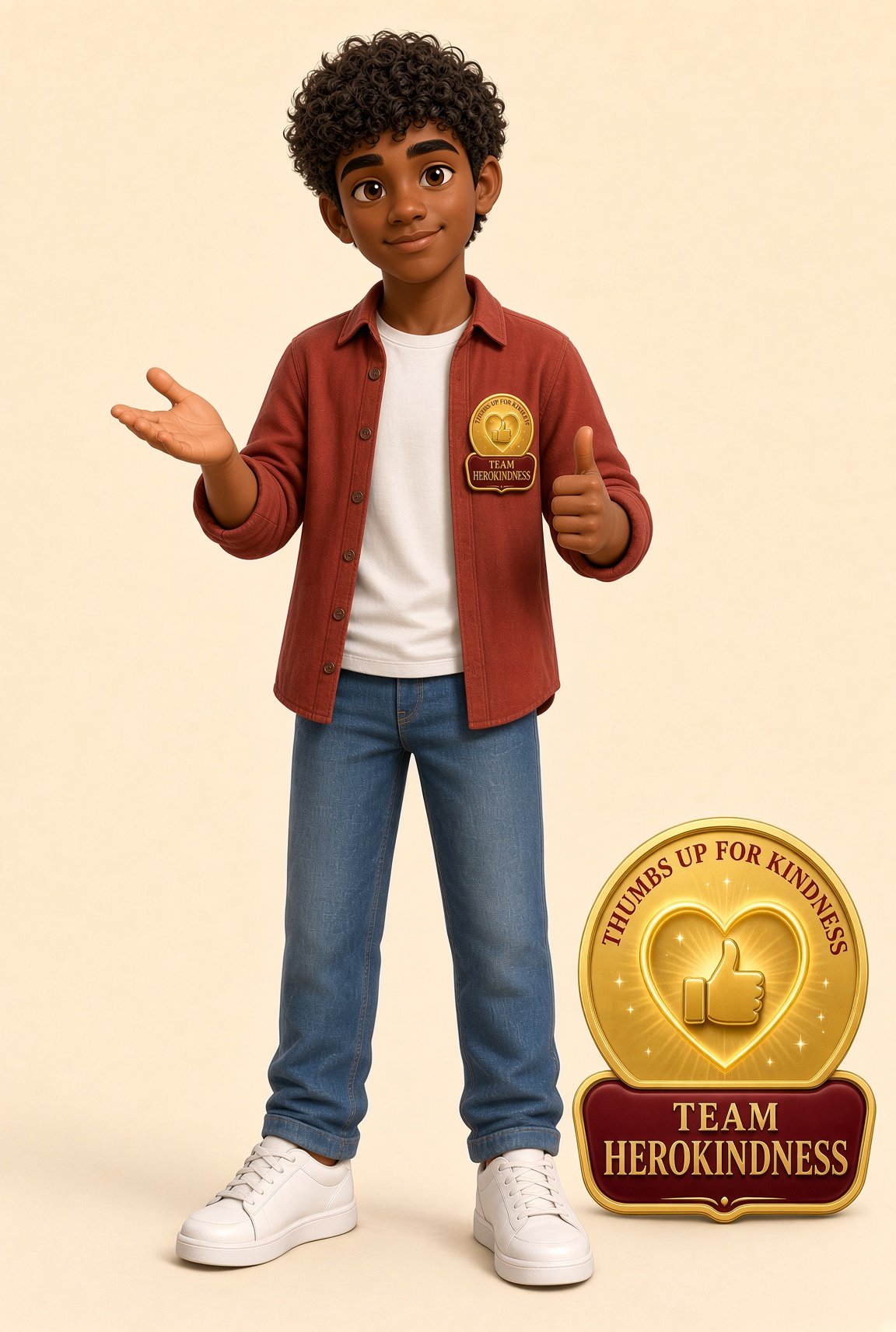
Kindness role: notices a chance to help — then chooses to help. Bags, doors, directions, a stuck screen, time with someone left out, or one kind thing for himself.
Notice. Choose. Help. That choice is the superpower.
Helper Hank has mastered the superpower of Help Choice. You can learn it, practice it in 3 lessons, and become Kindness Skill-Certified — ready to apply it.
Help Choice means you extend help by choosing to be kind. A helping hand can be physical, or it can be advice, directions, computer help, sharing a skill, or sharing time. You can use the same skill on yourself.
After you print the certificate, you can join Team HeroKindness. Say the Team Promise. Then wear the badge.
What Help Choice is
Help Choice is seeing a chance to help and deciding to take it. The kindness is the choice. The skill is following through.
Help can look like many simple things:
- Hands: hold a door, carry a bag, pick up a spill, stack a chair.
- Directions: help a new student find a classroom or sit with them at lunch.
- Skills: explain a math step, share supplies, show how a game works.
- Tech: help a sibling or grandparent with a video call, homework tab, or big button on the screen.
- Time: sit with someone left out. Call a family member. Stay with a friend who came alone.
- You: drink water, take a short rest, say one kind sentence to yourself, ask someone for help when you need it.
Hank’s line: “I’ve got a hand for that.” Then you help.
If you are not sure they want help, a simple ask is enough: “Want a hand?” Help Choice is still the decision to show up.
Practice makes the skill stronger
- Notice. Hands full. “I don’t get it.” Someone sitting alone. You feel worn out too.
- Choose. “I’ll help.” Or “I’ll help myself with one small kind thing.”
- Act. One clear help — carry, explain, point the way, sit with them, rest, ask.
- Feel it and repeat. School. Home. Friends. Community. You.
The skill: Help Choice
Learn it: I choose to help — me or you — in a way that fits.
How to use it:
- Notice a chance to help.
- Choose to be kind.
- Pick a way that fits: hands, directions, skills, tech, time, or self-kindness.
- Do it.
- Thumbs-up. The K-Spark™ starts when the choice becomes an act.
Impact on you: You feel useful, stronger, and proud. Helping yourself counts. Helping others gives the helper’s high.
Impact on others: A job gets lighter. A lonely moment gets company. Someone finds the room, the button, or a friend.
Collect it: Complete the 3 lessons. Print the certificate.
Where Help Choice shows up
In school: full arms at the door · dropped crayons · “I don’t get it” · a new student looking for a room · share supplies · explain one step · include someone left out · help tidy the board.
At home: grocery bags · a chore · snack for someone busy · hold the door for Grandpa · help with technology · read a page to a sibling · video-call a family member · give yourself ten minutes of rest.
With friends: pickup after the game · explain the rules · sit with the person on the edge · share time with someone who looks left out.
In the community: hold the door · pick up dropped items · check on a neighbor with a small task · pick up litter for 10 minutes · smile and say hello.
More everyday acts live in the Kindness Act Hub — Self, Home, School, and Community.
Help Choice Game · I’ve Got a Hand for That
Play in a circle. One person names a moment: arms full, lost in a hallway, stuck on a screen, sitting alone, tired after a hard day.
The next person says Hank’s line — “I’ve got a hand for that” — then names one way to help and acts it in ten seconds.
Ways to name: hands · directions · skills · tech · time · help myself.
Keep moments kind and small. No secrets. No teasing. No lifting people.
Kindness is a learnable superpower
No cape needed. Hank is the quiet helper from the Kindness Superpower list, made into a teammate. Mia notices. Izzy opens the circle. Hank chooses to help. Theo names the help so it is seen.
Help Choice is a skill kids want because it works fast. One choice can change a morning — theirs or yours. That warm, useful feeling after you help is the helper’s high.
How to develop Help Choice
- See the chance — bags, confusion, loneliness, a stuck screen, or your own heavy day.
- Choose kindness. Say the line if it helps: “I’ve got a hand for that.”
- Pick a way that fits — hands, directions, a skill, tech, time, or a kind thing for you.
- Do it with others when you can. “Want to help with me?” Two helpers spread the spark.
- If someone is hurt, get an adult. Help Choice includes getting the right help.
Examples for ages 7–12
School: hold the door · pick up crayons · help a new kid find the room · share a pencil · explain one step · sit with someone at lunch.
Home: grocery bags · a chore · show Grandma the big button on a video call · leave a kind note · take three deep breaths when you feel upset.
Playground: pickup after the game · rebuild a sandcastle · sit with the kid standing at the edge.
Online: help with a game setup or a shared file. Be kind on the screen too.
Examples for teens 13–17
School: lab bin · notes for someone who missed class · tutor one concept · include the person left out of the plan.
Home: bags from the car · a chore · help a parent or grandparent with technology · call a relative · rest without guilt for ten minutes.
Team / hangout: cooler, chairs, gear · stay with someone who came alone.
Online / community: share useful help on a group project · volunteer 10–15 minutes of cleanup · check on a neighbor.
Safety note
Help Choice is a kindness skill. It is not a job to lift people or do unsafe work. Do not take someone’s cane, wheelchair, or body.
If you are not sure they want help, ask. If someone is hurt, scared, or the moment is too big, get a trusted adult. Choosing to get an adult is still Help Choice.
If someone is in crisis or immediate danger in Canada, call 911, USA 988. In other countries, use your local emergency number.
Learn Help Choice in 3 lessons
Open one lesson. Print it. Run it at school or home. Each lesson is 15–20 minutes.
Lesson 1 · See a chance to help · 15–20 minutes
Help starts when you notice. The chance can be someone else — or you.
School: Pair up. A names a real small moment from today. B points to the chance to help and says Hank’s line. Switch. Include one “help myself” example.
Home: For ten minutes, notice chances to help at home. Choose one and do it.
Collect it: The chance I noticed was ____. I chose to help by ____.
Lesson 2 · Choose a way to help · 15–20 minutes
One moment can use different kinds of help. The skill is picking a way that fits.
School: Practice six ways on small made-up moments: hands · directions · skills · tech · time · help myself.
Home: Do one help for someone and one help for yourself (water, rest, kind words to you, or asking for help).
Collect it: The way I chose was ____. It helped because ____.
Lesson 3 · Help with others · 15–20 minutes
Part of Help Choice is engaging people around you — at school, home, with friends, in your community. Time with someone lonely counts.
School / friends: Invite one person: “Want to help with me?” Include someone left out.
Home / community: One real help that uses time or people — sit with someone, call a relative, pick up litter, help a neighbor with an adult nearby.
Collect it: I helped ____. I invited ____. What changed was ____. If I needed an adult, I would tell ____.
Print for class or home
Each button prints one letter page.
THUMBS UP FOR KINDNESS
Teacher sheet · Helper Hank · Help Choice
Skill: Notice. Choose to help. Do it.
Line: “I’ve got a hand for that.”
Help can be physical, directions, tech, advice, time, or a kind thing for yourself.
3 lessons · 15–20 minutes each
- Lesson 1 · See a chance to help — including help for yourself.
- Lesson 2 · Choose a way that fits. Practice six kinds of help.
- Lesson 3 · Invite someone to help with you. Include a person left out.
- Play “I’ve Got a Hand for That.” Keep moments kind and small.
- After Lesson 3, print Kindness Skill-Certified certificates.
- After Lesson 3, kids may print the certificate, say the Team Promise on the character page, and wear the Team HeroKindness badge. The badge is a signal, not a rank.
First names only. If someone is hurt, get an adult.
If someone is in crisis or immediate danger in Canada, call 911, USA 988. In other countries, use your local emergency number.
thumbsupforkindness.com/team-herokindness-helper-hank
THUMBS UP FOR KINDNESS
Parent sheet · Helper Hank · Help Choice
Skill: Notice. Choose to help. Do it.
Line: “I’ve got a hand for that.”
Help is bags and doors — and also directions, computer help, time with someone lonely, and kindness to yourself.
- Lesson 1: notice one real chance to help at home. Choose it.
- Lesson 2: one help for someone + one help for yourself.
- Lesson 3: help with someone else, or share time — a call, a sit-with, a neighbor task with you nearby.
- After Lesson 3, kids may print the certificate, say the Team Promise on the character page, and wear the Team HeroKindness badge. The badge is a signal, not a rank.
Kids: door, crayons, “I don’t get it,” sit with a sibling, a short rest.
Teens: bags, gear, group work, tech help, a check-in, asking for help too.
If someone is in crisis or immediate danger in Canada, call 911, USA 988. In other countries, use your local emergency number.
thumbsupforkindness.com/team-herokindness-helper-hank
THUMBS UP FOR KINDNESS · HELPER HANK
Lesson 1 · See a chance to help
Time: 15–20 minutes
Line: “I’ve got a hand for that.”
Help starts when you notice. The chance can be someone else — or you.
School: Pair up. A names a real small moment. B points to the chance to help and says Hank’s line. Switch. Include one “help myself” example.
Home: For ten minutes, notice chances to help. Choose one and do it.
Collect it: The chance I noticed was ____. I chose to help by ____.
If someone is hurt or the moment is bigger than a help, get an adult. Canada / USA emergency: 911. USA crisis: 988.
thumbsupforkindness.com/team-herokindness-helper-hank
THUMBS UP FOR KINDNESS · HELPER HANK
Lesson 2 · Choose a way to help
Time: 15–20 minutes
One moment can use different kinds of help. Pick a way that fits.
Six ways: hands · directions · skills · tech · time · help myself.
School: Practice each way on a small kind moment. Say the line. Act it for ten seconds.
Home: Do one help for someone and one help for yourself (water, rest, kind words to you, or asking for help).
Collect it: The way I chose was ____. It helped because ____.
Do not lift people or do unsafe work. Canada / USA emergency: 911. USA crisis: 988.
thumbsupforkindness.com/team-herokindness-helper-hank
THUMBS UP FOR KINDNESS · HELPER HANK
Lesson 3 · Help with others
Time: 15–20 minutes
Part of Help Choice is engaging people around you. Time with someone lonely counts.
School / friends: Invite one person: “Want to help with me?” Include someone left out in a game, cleanup, or walk to class.
Home / community: One real help that uses time or people — sit with someone, call a relative, pick up litter for 10 minutes, help a neighbor with an adult nearby.
Collect it: I helped ____. I invited ____. What changed was ____. If I needed an adult, I would tell ____.
Choosing to get an adult is still Help Choice. Canada / USA emergency: 911. USA crisis: 988.
thumbsupforkindness.com/team-herokindness-helper-hank
Become Kindness Skill-Certified · Help Choice
I have the superpower skill of helping.
Certificate of Kindness Superpower Skill
Kindness Skill-Certified · Help Choice
This certifies that
has learned and practiced the superpower of Help Choice
with Helper Hank of Team HeroKindness™
and is Kindness Skill-Certified — ready to apply this superpower.
“I’ve got a hand for that.”
Notice. Choose to help. Do it.
Hands, directions, skills, tech, time, and kindness to yourself.
Well done!
Next: say the Team Promise and join Team HeroKindness™.
Awarded by ThumbsUpForKindness.com
Team HeroKindness™
You learned the skill. Now you can join the team.
The certificate means you practiced Help Choice with Helper Hank. The Team Promise is how you join. The badge means you will keep using the skill.
- Print your certificate for this skill.
- Use it once for real — see the first mission below.
- Say the Team Promise out loud with a parent, teacher, or friend.
- Wear the badge as a signal, not a rank.
The Team Promise
I learned a kindness skill.
I will use it.
I will not use the badge to boss anyone.
I will help kindness travel — one thumbs up, one thank you, one act at a time.
No account needed. Say it. Mean it.
First mission · Help Choice
Notice one chance to help. Ask first. Help. Don’t take over.
“I’ve got a hand for that.”
See how Team HeroKindness works →
Download the Team HeroKindness badge →